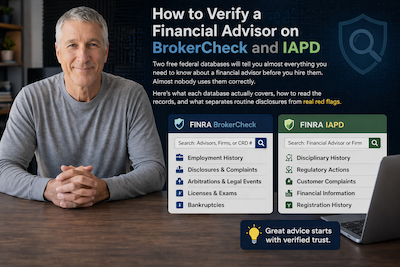
Every financial advisor you might hire has a public regulatory record. Two federal databases — free, searchable, and authoritative — hold the information that matters most: who's licensed, what they're licensed for, what firms they've worked at, whether they've been disciplined, and whether customers have ever successfully disputed their conduct.
Almost nobody uses these databases well. Most people either don't know they exist, or they glance at them for thirty seconds, see the word "disclosures" on a record and either panic unnecessarily or miss what the disclosures actually say.
I built this directory partly around verifying these records at scale. Every advisor listing on this site links back to the relevant regulatory database so you can do your own check. But the link is only useful if you know how to read what you find. This post is that walkthrough.
The two databases (and the gap between them)
There are two main regulators for financial advisors in the United States, and they each maintain their own database:
FINRA BrokerCheck (brokercheck.finra.org) covers registered representatives — brokers and broker-dealers regulated by FINRA. If someone sells securities, annuities, or certain insurance-linked investments on commission, they're likely here.
SEC Investment Adviser Public Disclosure (IAPD) (adviserinfo.sec.gov) covers investment advisers — people who provide advice for a fee, regulated by the SEC or state securities regulators. Fee-only financial planners, registered investment advisory firms (RIAs), and wealth managers are usually here.
Many advisors are dually registered — they're both a broker and an investment adviser, under different regulatory hats for different activities. You'll find these people on both databases. You need to check both, because a disciplinary event on the broker side won't show up on the investment-adviser side, and vice versa.
BrokerCheck and IAPD actually share most underlying data (they're both fed by the Central Registration Depository, or CRD, which is the industry's master registration system). But the interfaces present the data differently, and some filings — especially firm-level Form ADV disclosures on the investment-adviser side — only appear on IAPD.
Rule of thumb: always check both databases, even if you only think you need one. The searches are free and take five minutes.
How to search
Both databases support searching by individual name, firm name, or CRD number (the unique ID assigned to each registered person and firm). If an advisor has given you a business card with their CRD number, use that — it's unambiguous. Names alone can return multiple matches, especially for common names.
On BrokerCheck: go to brokercheck.finra.org, type the name in the search box, and filter by individual or firm. Results show a snapshot with CRD number, current registration status, firms employed with, and "disclosures" count.
On IAPD: go to adviserinfo.sec.gov, use "Investment Adviser Search." Individual and firm searches are separate tabs. The interface is older and occasionally clunky, but the underlying data is the same.
Download the full report (PDF) rather than relying on the snapshot view. The snapshot hides detail that sometimes matters.
What an individual advisor's record tells you
Read the record in roughly this order:
1. Registration history
When did they register, with which states, and for what types of securities? A broker with 25 years of registration history has a track record; a broker with 3 months of history has barely begun the process that typically includes the bad years. Neither is automatically disqualifying — new advisors deserve careers — but it's context for how much signal their clean record provides.
Look at states. Advisors are registered by state. Someone who registered in six states recently may be building out a national practice, or may be moving around ahead of regulatory attention. The record alone won't tell you which, but it's a flag to ask about.
2. Exam history
The big exams to know:
- Series 7 — general securities representative. The classic "stockbroker" exam.
- Series 65 or 66 — required to give investment advice for a fee (Series 66 combines 65 with Series 63 for state-level registration).
- Series 24, 26, 27, 28 — various principal / supervisory licenses. If someone has these, they're in a supervisory role at their firm.
Professional designations (CFP, CFA, ChFC, etc.) are not shown on regulatory records — those come from separate certifying bodies. BrokerCheck and IAPD only show regulatory exams.
3. Firms employed with
Look at the pattern. A 20-year advisor at one firm is qualitatively different from a 20-year advisor at six firms in 20 years. Frequent moves aren't automatically disqualifying — firms get acquired, management teams leave, and good advisors sometimes follow opportunities — but rapid turnover (three or more firms in five years) deserves a direct question: why did they leave each place?
The answer you want: coherent, positive reasons (acquisition, better platform, founding their own firm). The answer that concerns me: vague answers, inconsistent stories, or histories that include firms known for high turnover and compliance issues.
4. Disclosures
This is where attention is warranted, and also where people most often misread the record.
"Disclosures" is regulator-speak for any event that the regulator requires to be reported. The categories include:
- Customer disputes (filed complaints, settled disputes, arbitration awards)
- Regulatory events (actions by FINRA, the SEC, state regulators)
- Criminal events (felony or investment-related misdemeanor charges or convictions)
- Financial events (personal bankruptcies, unpaid judgments, tax liens)
- Employment separations after allegations (what's called a "termination for cause" or similar)
"No disclosures" means the advisor has a clean record. But disclosures do not automatically mean a bad advisor. Interpretation matters.
Reading disclosures correctly
Not all disclosures are equal. Here's how I think about them:
Low-concern (often):
- A single customer dispute that was denied or withdrawn. Dispute filings don't require evidence; customers sometimes file for reasons that don't pan out.
- A small settlement paid by the firm (not the individual), especially if it's a modest dollar amount and decades old.
- A personal bankruptcy filing, especially if it's old and tied to a documented life event (medical, divorce). Past financial trouble doesn't automatically mean current risk.
- A single regulatory matter resolved with a small fine and no suspension.
Moderate-concern (ask questions):
- Multiple customer disputes in a short period. Pattern matters more than any single event.
- Settlements where the individual (not just the firm) paid out.
- Regulatory matters involving suitability violations, concentrated recommendations, or failure to supervise.
- A termination for cause at a prior firm, especially if the stated allegation is serious.
High-concern (walk away, or dig very deep):
- A regulatory suspension or bar (even lifted or expired).
- Criminal convictions for fraud, theft, or investment-related offenses.
- Multiple regulatory events across different regulators.
- Large customer settlements where the advisor paid personally.
- Pending regulatory investigations — these will show as "pending" in the record.
Read the full disclosure narrative when one exists. The record includes the alleged facts, the disposition, and sometimes the advisor's response. The response can reveal a lot — some advisors explain calmly and factually; others respond defensively or refuse to engage. Both tell you something.
What the firm's record tells you
Individual advisors work under a firm. The firm's record — especially Form ADV Part 1 for RIAs — covers facts the individual's record doesn't:
- Assets under management (AUM). Total client assets managed by the firm, as of the most recent filing.
- Number of accounts and employees. Is this a solo advisor or a 50-person firm? The expected service model is completely different.
- Client composition. What percentage of clients are high-net-worth individuals, institutions, trusts, etc.? An advisor whose book is 90% ultra-high-net-worth is probably not set up to serve a $200,000 retirement account well — not because they'd do a bad job, but because you won't be their priority.
- Services offered. Financial planning, portfolio management, wrap-fee programs, pension consulting, etc.
- Compensation methods. Asset-based fees, hourly fees, fixed fees, commissions, performance-based fees — and what percentage of revenue comes from each.
- Custody disclosures. Does the firm have custody of client assets? Or is custody held by an independent custodian (Schwab, Fidelity, Pershing)? Independent custody is the industry norm and a meaningful protection — firms that self-custody have a much higher fraud risk.
- Disciplinary history of the firm as an entity. Even if the individual is clean, the firm may have a history.
Form ADV Part 2A is a longer brochure that includes fee schedules, specific services, conflicts of interest, and investment strategies. Every RIA is required to deliver this to you before engaging — and they're required to update it when material things change. It's one of the single best documents to actually read before hiring someone. Don't skim it; read the conflicts-of-interest section in particular.
Part 2B is the individual advisor's supplement — education, professional designations, disciplinary information specific to them. Short document, worth reading.
Common mistakes when reading these records
Mistake 1: Panicking at "disclosures." As above, not all disclosures are equal. Read them.
Mistake 2: Checking only one database. A dually registered advisor can have a clean broker record and a problematic investment-adviser record, or vice versa.
Mistake 3: Ignoring the firm. Individual records are important, but the firm's record, AUM, custody setup, and client composition often matter more for predicting whether you'll be well-served.
Mistake 4: Trusting a "no disclosures" record too much on a new advisor. A three-year-old career hasn't had time to accumulate complaints whether or not the advisor is trustworthy. "No disclosures" is necessary, not sufficient.
Mistake 5: Not cross-checking claimed credentials. If an advisor claims CFP, verify it at letmeknow.cfp.net. If they claim CFA, verify at cfainstitute.org. The regulatory databases don't catch fake credentials; the certifying bodies do.
Mistake 6: Skipping Form ADV Part 2A. This is the single document that tells you what an RIA actually does, how they charge, and what their conflicts of interest are. Read it.
A step-by-step workflow
Here's the process I'd run before hiring any advisor:
- Get the advisor's full name and CRD number (or firm CRD).
- Search BrokerCheck. Download the full PDF report. Read registration history, firms, and disclosures in full.
- Search IAPD. Same process. Compare against BrokerCheck.
- Pull the firm's Form ADV Part 1 and Part 2A from IAPD. Read Part 2A end to end — especially the fees, services, conflicts of interest, and custody sections.
- Verify any claimed credentials (CFP, CFA, ChFC, CPA) at the certifying body.
- Search the firm name plus "SEC action" or "FINRA enforcement" on a search engine. Regulatory press releases sometimes surface context the records summarize in one line.
- Ask the advisor directly about any disclosure or employment transition that raised a question. Their answer — its content, its tone, its consistency — is meaningful.
- Document what you found somewhere you can reference later. If you onboard and something later goes wrong, you'll want the record of what you knew when.
The whole process takes about an hour for a thorough check. An hour against a multi-decade relationship involving your life savings is a reasonable trade.
Why this is worth doing even if an advisor is recommended by someone you trust
Personal referrals are helpful signals, but they don't replace the record. The person recommending their advisor knows how their experience has gone, which may not reflect the advisor's treatment of other clients, any regulatory events since the referrer became a client, or issues that haven't yet surfaced publicly.
Regulatory databases are one of the very few places where the same facts are available to everyone, at no cost, regardless of who you know. Use them.
This post was written by Kevin Collins, who built this directory partly around verifying advisor records from FINRA and SEC databases at scale. More about the craft-and-operations perspective behind the site is on the About page. For the security posture to protect your accounts once you've hired someone, see the security checklist for your financial accounts. Nothing in this post is personal financial advice — it's a data-literacy walkthrough of public regulatory records. If you want to hire a fiduciary advisor, our directory lists them across every state; verify any advisor on FINRA BrokerCheck before you engage.