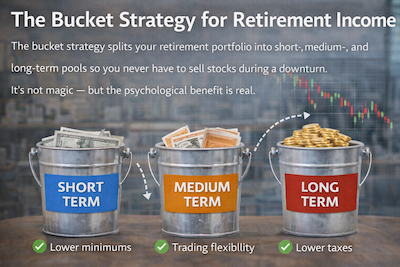
The single biggest risk in early retirement isn't running out of money over 30 years — it's having to sell stocks at the worst possible time during a market downturn in the first 5 to 10 years. That's the heart of sequence-of-returns risk, and the bucket strategy is one of the most popular approaches to managing it.
The strategy isn't complicated, isn't new, and isn't magic. But for the right person it's a meaningful improvement over a single-pool balanced portfolio. Here's the case for it, and the case against.
The Basic Setup
The bucket strategy splits your retirement portfolio into three pools, each designed to fund a different time horizon:
Bucket 1: Cash and short-term (1–2 years of expenses)
- Holdings: High-yield savings, money market funds, short-term Treasury bills, CD ladders.
- Purpose: Cover near-term expenses without ever needing to sell anything during a market downturn.
- Yield: Low — but that's not the point. This bucket exists to provide certainty, not return.
Bucket 2: Intermediate (3–7 years of expenses)
- Holdings: Short- to intermediate-duration bond funds, dividend-paying stock funds, conservative balanced funds.
- Purpose: Generate moderate returns and act as a refilling source for Bucket 1 when it's drawn down.
- Yield: Moderate — bond funds with 4–6% yields, balanced funds with 5–7% expected returns.
Bucket 3: Long-term growth (8+ years of expenses)
- Holdings: Equity funds — domestic stocks, international stocks, REITs.
- Purpose: Generate the long-term growth that funds the back half of retirement.
- Yield: Volatile but historically the highest — 7–10% nominal long-term.
For a retiree spending $80,000/year, a typical bucket allocation looks like:
- Bucket 1: $80,000–$160,000 in cash (1–2 years)
- Bucket 2: $240,000–$560,000 in bonds (3–7 years)
- Bucket 3: Everything else in equities (the rest of the nest egg)
If the total nest egg is $2,000,000, the split might be:
- $120,000 in cash (6%)
- $400,000 in intermediate (20%)
- $1,480,000 in equities (74%)
That's similar to a traditional 70/30 stock/bond split, but with a meaningful cash carve-out from the bond side.
Why It Helps: The Psychological and Mathematical Case
The strategy works on two levels.
The mathematical case (modest)
If you never have to sell equities during a downturn, you avoid locking in losses. Equities recover; cash withdrawn for living expenses doesn't get the chance.
Studies of bucket strategies vs. traditional rebalanced portfolios generally find the difference is small in long-term total return, often 0.1–0.3% per year. Sometimes the bucket strategy slightly underperforms, sometimes it slightly outperforms. The math itself isn't a knockout argument.
The psychological case (significant)
Where the strategy genuinely helps is in behavior. A retiree watching the S&P 500 drop 30% in three months is much less likely to panic-sell if they know the next two years of expenses are sitting in cash, completely insulated from the carnage. They have time to wait for markets to recover before having to sell anything from the equity bucket.
That behavioral advantage isn't trivial. The biggest threat to a 30-year retirement plan isn't sequence risk on paper — it's the retiree who panics in year three of a bear market and moves everything to cash, then misses the recovery. Bucket structure makes that less likely.
How Refilling Works (the Operational Question)
The trickiest part of the bucket strategy isn't setting it up — it's what to do as you spend it down. There are three common approaches.
1. Mechanical refill (most common)
When Bucket 1 drops below a threshold (say, 9 months of expenses remaining), refill it from Bucket 2. When Bucket 2 drops below its target, refill from Bucket 3.
The refilling decisions get made on a schedule — often annually — regardless of market conditions.
2. Opportunistic refill
You only refill from a higher bucket when that bucket is up. If Bucket 3 (equities) had a strong year, you sell some equity gains to refill Bucket 1 and Bucket 2. If Bucket 3 is down, you let Bucket 1 keep draining and pause the refill.
This is closer to "buy low, sell high" — but it requires patience to let Bucket 1 run lower than feels comfortable in down years, with the discipline to refill aggressively in up years.
3. Rules-based refill (Guyton-Klinger guardrails)
A more sophisticated approach combines bucket structure with dynamic withdrawal rules. The Guyton-Klinger framework calls for cutting your withdrawal by 10% when your portfolio drops below a threshold, and increasing it by 10% when above. Combined with bucket structure, this can extend portfolio longevity and provide more spending in good years.
Who Benefits Most
The bucket strategy is most valuable for:
- Early retirees (under 65) who have a long horizon and meaningful sequence-of-returns risk.
- Behavioral worriers — anyone who knows they'd lose sleep watching their entire portfolio swing in a bear market.
- Lump-sum retirees — someone retiring with a defined benefit cash-out, business sale proceeds, or large rollover all at once. The bucket structure provides discipline for managing a sudden lump sum.
- Retirees with no pension or limited Social Security — when more of your income depends on the portfolio, the cushion matters more.
Who It's Less Useful For
- Retirees with strong pension + Social Security coverage. If 80% of your expenses are covered by guaranteed inflation-adjusted income, sequence risk on the residual is small. A simpler balanced portfolio is fine.
- Retirees who have already proven they don't panic. If you held through 2008 and 2020 without making changes, you may not need the structural cushion.
- Anyone who'll over-allocate to cash because the bucket model "tells them to." Cash earns less than bonds long-term. A 5-year cash bucket on a $2M portfolio is $400K earning 4% in money market while equities historically return 7–10%. The opportunity cost is real.
Common Mistakes
Letting the cash bucket grow too large
A 5-year or 7-year cash bucket sounds safe but creates serious drag on long-term returns. 1–3 years is the typical sweet spot for most retirees.
Failing to refill in up years
Some people start with a beautiful bucket structure, then watch Bucket 1 drain to near-zero in a down market while Bucket 3 has a strong recovery year — and never refill, because they're worried "the next downturn could come anytime." If you don't refill discipline-wise, the structure stops working.
Using bucket structure as an excuse to hold too much equity
Some retirees decide that because they have 1–2 years of expenses in cash, they can hold 90% equity in Bucket 3. Maybe. But only if you've genuinely thought through what would happen in a 50% drawdown lasting 3+ years.
Confusing buckets with asset location
Buckets are about time horizon. Asset location is about which account type holds what. They're separate decisions. Your equity bucket should be in tax-advantaged accounts where it can compound; your bond bucket can sit in either tax-deferred (where the interest is sheltered) or taxable (where municipal bonds work). Mixing the two concepts up causes problems.
The Honest Verdict
The bucket strategy is not magic. A traditional 60/40 rebalanced portfolio can produce similar long-term outcomes. What buckets really do is provide a structural framework that helps retirees stay invested through volatile markets — and that behavioral benefit is worth real money.
If you're disciplined and unlikely to panic in a downturn, you don't need the bucket structure to get the same outcome. If you're anyone else, the structure earns its keep by changing your behavior even if it doesn't change the math much.
Implementation Checklist
If you decide to use the bucket strategy:
- Calculate your annual retirement expenses. Be honest, not aspirational.
- Set Bucket 1 = 1–2 years of expenses in high-yield savings or short-term Treasuries.
- Set Bucket 2 = 3–7 years of expenses in short/intermediate bond funds or balanced funds.
- Put the remainder in Bucket 3 — diversified equity index funds (domestic, international, maybe a REIT slice).
- Decide your refill rule in advance — mechanical, opportunistic, or guardrail-based — and write it down.
- Review annually, not constantly.
- Stress-test against a 30% drop in Bucket 3. Does the structure hold up?
The Bottom Line
The bucket strategy is one of several legitimate frameworks for managing retirement income. It's not better than alternatives mathematically — but for retirees who would otherwise sell stocks in a panic during a downturn, it can be the difference between a successful 30-year retirement and a portfolio that runs out of money.
If you want help designing the bucket structure for your specific situation — which accounts hold which buckets, how to handle Roth conversions across buckets, how to integrate Social Security timing — talk to a CFP who specializes in retirement income. Our directory lists fiduciary advisors with retirement-income expertise across every state. Verify any advisor on FINRA BrokerCheck before you commit.