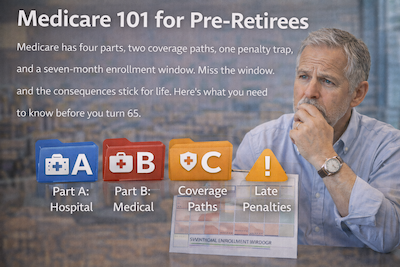
Medicare is bureaucratic but it isn't actually complicated once you understand the structure. The problem is most people encounter it for the first time about six months before they turn 65, feel overwhelmed by the acronyms, pick the wrong coverage path, and then can't easily change later.
This guide covers what to know before you enroll — ideally starting at least a year before age 65.
The Four Parts of Medicare
Medicare is divided into four parts. Each part covers something different.
Part A — Hospital Insurance
Covers inpatient hospital stays, skilled nursing facility care, hospice, and some home health care. Most people pay nothing for Part A because they (or a spouse) paid Medicare taxes through payroll for at least 10 years.
- Deductible (2024): $1,632 per benefit period (a benefit period starts when you're admitted to the hospital and ends after 60 days with no hospital/SNF services)
- Coverage: Day 1–60 fully covered after deductible. Day 61–90 has a $408/day copay. Day 91+ uses "lifetime reserve days" or you pay the full cost.
Part B — Medical Insurance
Covers doctor visits, outpatient care, preventive services, durable medical equipment, and most diagnostic tests. Everyone pays a monthly premium for Part B, and most retirees pay the standard rate.
- Standard monthly premium (2024): $174.70
- Deductible (2024): $240 per year
- Coverage after deductible: Medicare pays 80% of Medicare-approved costs; you pay 20% (with no annual out-of-pocket maximum on original Medicare)
Part C — Medicare Advantage
An alternative to "original Medicare" (Parts A and B). Private insurance companies offer bundled plans that combine A, B, and usually D (prescription) into a single plan, often with extras like vision, dental, and hearing.
- Monthly premium: Varies widely — many Medicare Advantage plans have $0 premium (beyond the Part B premium you still owe). Some have premiums of $50–$200.
- Trade-offs: Networks (you're typically restricted to the plan's network of doctors and hospitals), prior authorization (plans often require pre-approval for procedures), and geographic limitations (plans are county-specific).
Part D — Prescription Drug Coverage
Covers prescription drugs. Available as a standalone plan (for people on original Medicare + Medigap) or bundled into most Medicare Advantage plans.
- Monthly premium: $0 to $100+, varies widely by plan
- Coverage: Three-tiered — a deductible, initial coverage, a "coverage gap" (reduced by legislation over recent years), and catastrophic coverage
Two Coverage Paths
Approaching 65, you essentially choose between two paths:
Path A: Original Medicare + Medigap + Part D
You stay on government-administered Parts A and B, plus you buy:
- A Medigap (Medicare Supplement) plan — a private insurance policy that covers the 20% Medicare doesn't pay (deductibles, copays, coinsurance). Medigap plans are standardized across companies (Plan G, Plan N, Plan F for pre-2020 enrollees, etc.).
- A standalone Part D plan for prescription drugs.
Pros: Any doctor or hospital that accepts Medicare nationwide. No referrals needed. Predictable costs after premiums. No surprise bills.
Cons: More expensive monthly (Medigap Plan G for a 65-year-old typically runs $120–$220/month on top of Part B). Dental, vision, and hearing not covered unless you buy separate supplemental policies.
Path B: Medicare Advantage (Part C)
Skip Medigap and the standalone Part D — you get A, B, and usually D bundled through one private insurer's plan.
Pros: Lower monthly premium (often $0). Usually includes dental, vision, hearing, and sometimes gym memberships and transportation. Predictable copay structure.
Cons: Network restrictions (in-network costs are low; out-of-network can be very expensive or completely uncovered). Prior authorization requirements. Geographic limitation (if you travel or snowbird, MA plans may not cover out-of-area care). Higher maximum out-of-pocket in a bad health year (typically $5,000–$9,000 vs. ~$5,000 for Medigap Plan G).
The single biggest trap with Medicare Advantage: if you enroll initially and want to switch to original Medicare + Medigap later, you can be medically underwritten for Medigap in most states. That means if you've developed a health condition after turning 65, Medigap insurers can deny you, charge more, or exclude pre-existing conditions. Your one-time right to buy ANY Medigap plan without medical underwriting expires six months after you first enroll in Part B. Four states (New York, Connecticut, Massachusetts, Maine) have guaranteed-issue rules that protect this right; everywhere else, it's a real concern.
The Enrollment Window
Your Initial Enrollment Period is a 7-month window around your 65th birthday: the 3 months before your birthday month, your birthday month, and the 3 months after.
- Enroll in the 3 months before: coverage starts on the first day of your birthday month.
- Enroll in your birthday month: coverage starts the month after.
- Enroll in the 3 months after: coverage starts 2–3 months after enrollment.
Missing the Initial Enrollment Period is expensive. If you don't enroll when first eligible and don't have qualifying coverage elsewhere (e.g., employer coverage for active work), you'll pay:
- Part B late-enrollment penalty: 10% of the standard premium for each full 12-month period you could have had Part B but didn't. This penalty is permanent — you pay it every month for the rest of your life. A 3-year delay = 30% premium surcharge forever.
- Part D late-enrollment penalty: Roughly 1% of the "national base beneficiary premium" per month of delay. Also permanent.
If you're still working at 65
If you (or your spouse) have active employment with group health coverage at a company with 20+ employees, you can delay Part B enrollment without penalty. Your "Special Enrollment Period" begins when you or your spouse retire or lose the employer coverage, and lasts 8 months from that event.
Important nuances:
- COBRA and retiree health coverage do not count as "active employment coverage" for delaying Part B. If you retire and go on COBRA, your 8-month SEP clock starts at retirement, not when COBRA ends.
- Companies with fewer than 20 employees: Medicare becomes primary coverage at 65 whether you enroll or not. Not enrolling means you could be left with almost no coverage and accruing late-enrollment penalties. Enroll on time at small employers regardless of active coverage.
- If you have an HSA, enrolling in any part of Medicare ends your eligibility to contribute to an HSA. Many people delay Medicare Part A enrollment specifically to keep contributing to an HSA past age 65.
IRMAA: The Income Surcharge
Income-Related Monthly Adjustment Amount (IRMAA) surcharges increase your Medicare Part B and Part D premiums if your income exceeds certain thresholds.
For 2024, single-filer thresholds (based on 2022 income):
- Up to $103,000: standard premium ($174.70)
- $103,001–$129,000: +$69.90 (total $244.60)
- $129,001–$161,000: +$174.70 (total $349.40)
- $161,001–$193,000: +$279.50 (total $454.20)
- $193,001–$500,000: +$384.30 (total $559.00)
- Above $500,000: +$419.30 (total $594.00)
Married filing jointly thresholds are roughly 2×.
Two things to know about IRMAA:
- It's based on income from two years prior. Your 2024 IRMAA uses your 2022 tax return. This makes planning possible — you can see IRMAA coming if you had a high-income year.
- It's a cliff, not a slope. Crossing a threshold by $1 costs the same as crossing by $5,000. Large Roth conversions, capital gain realizations, and other income-adjusting moves need to stay below the relevant IRMAA threshold. This is one of the most common mistakes in retirement tax planning.
You can request a reduction in IRMAA if you've had a life-changing event (retirement, spouse death, divorce, job loss) — file Form SSA-44 with Social Security.
Medicare + Employer Coverage Decision
If you're 65 and still working:
Employer has 20+ employees: Typically stay on employer coverage. Delay Part B, enroll in Part A (it's usually free). Evaluate your plan against Medicare annually — some employer plans are genuinely better, some aren't.
Employer has <20 employees: Medicare becomes primary. Enroll in Parts A and B on schedule. Your employer plan will generally pay as secondary, covering what Medicare doesn't.
Employer offers an HDHP with HSA: Stay on it if the HDHP is a good plan, for one big reason — you can continue contributing to the HSA, which you can't do on Medicare.
Common Mistakes
- Missing the 7-month enrollment window and getting hit with lifetime Part B penalties.
- Choosing Medicare Advantage at 65 without understanding the switching limitations later. Try original Medicare + Medigap first if you're healthy; you can usually switch to MA later without penalty, but not the reverse.
- Contributing to an HSA after enrolling in Medicare — any Medicare part, including Part A at 65. IRS penalties for excess HSA contributions.
- Ignoring IRMAA when doing Roth conversions. A conversion that pushes you over a threshold adds $1,000+/year to Medicare premiums per spouse for the next two years.
- Assuming COBRA protects you from Part B penalties. It doesn't.
- Not comparing Medicare Advantage plans annually. Plans change every year — networks shrink, copays rise, benefits change. You have an open enrollment window from October 15 to December 7 each year to change plans.
The Bottom Line
Medicare isn't hard, but the consequences of mistakes are long-lasting. Start researching at least 6 months before your 65th birthday. Pick between original Medicare + Medigap (predictable, flexible, more expensive monthly) and Medicare Advantage (cheaper upfront, network-restricted, harder to leave later). Enroll on time unless you're actively working at a large employer. Watch IRMAA when doing Roth conversions or realizing large gains.
A CFP who specializes in retirement income planning can coordinate Medicare decisions with your Social Security claiming strategy, Roth conversions, and withdrawal sequencing. Our directory lists fiduciary advisors across every state, many of whom hold the Retirement Income Certified Professional (RICP) designation. Verify any advisor on FINRA BrokerCheck before you commit.