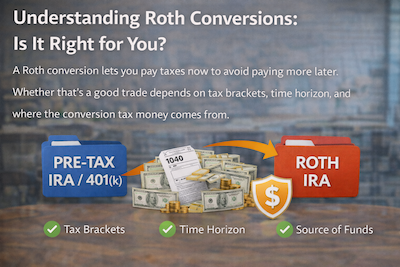
A Roth conversion sounds like wizardry: take money out of a Traditional IRA, pay tax on it now, put it into a Roth IRA, and never owe tax on the gains again. Done correctly, it's one of the highest-leverage tax moves available to retirees and pre-retirees. Done carelessly, it's an expensive mistake that adds tax cost without benefit.
Whether it's right for you comes down to four variables: your current tax bracket, your future tax bracket, your time horizon, and where the money to pay the conversion tax comes from.
What a Roth Conversion Actually Is
You take some amount — say $50,000 — from a Traditional IRA (or Traditional 401(k), if your plan allows in-plan conversions). The custodian moves the money to a Roth IRA. The $50,000 is added to your taxable income for the year. You pay federal and state income tax on it at your marginal rate.
From that moment on, the money grows tax-free in the Roth and you'll never owe income tax on either the original conversion or the future growth (assuming you follow the rules around when you can withdraw).
The Roth IRA also has no Required Minimum Distributions during the original owner's lifetime. The Traditional IRA forces you to start taking RMDs at age 73, whether you need the money or not. Conversions reduce future RMDs proportionally.
The Core Math
The decision to convert is simply: will the marginal tax rate I pay today be lower than the marginal tax rate I'd pay when this money comes out later?
If yes — convert. You're locking in a lower tax rate.
If no — don't convert. You'd be paying more tax now to avoid less tax later. That's a net loss.
If they're roughly equal — the answer hinges on secondary factors: estate planning, RMD avoidance, tax diversification.
The complicating factor is that "future tax rate" isn't a single number. It depends on:
- Your retirement income sources (Social Security, pension, RMDs, withdrawals)
- Future tax law changes (the 2017 tax cuts are scheduled to sunset at end of 2025; current brackets may not be the brackets you face in 2030)
- Where you'll live (state income tax matters)
- Whether you'll be married or widowed (the single filer brackets are dramatically tighter)
- Whether your heirs will eventually inherit it (their tax bracket matters too)
When Conversions Make Sense
The cleanest cases for converting:
The "gap years" between retirement and Social Security / RMDs
Many retirees have a window from age 60–73 where their income is unusually low. They've stopped working but haven't started Social Security or RMDs. If you have a $1.5M Traditional IRA and you're spending $50,000/year out of cash savings, your taxable income is low — maybe in the 12% federal bracket.
Converting up to the top of the 12% or 22% bracket each year of those gap years is one of the highest-value tax moves available. You're paying 12–22% now on money that will eventually be forced out as RMDs at potentially 24%, 32%, or higher.
You're a high earner now, but your spouse will outlive you
Married filing jointly brackets are roughly twice as wide as single filer brackets. When one spouse passes, the survivor inherits the assets but files single going forward. The same income that produced a 22% marginal bracket together might produce 32% alone.
If you expect a meaningful surviving-spouse period, converting some money to Roth while you're still filing jointly can be a substantial win.
You expect future tax rates to rise
The 2017 Tax Cuts and Jobs Act expires at the end of 2025. Without legislative renewal, brackets reset upward — the 22% bracket becomes 25%, the 24% becomes 28%, the 32% becomes 33%, and the 37% becomes 39.6%. Even with renewal, long-term federal debt pressure makes higher brackets a reasonable bet for the next 20–30 years.
If you genuinely believe rates are heading up, converting at today's lower brackets locks in the savings.
You want to leave money to non-spouse heirs
Under the SECURE Act, non-spouse beneficiaries who inherit a Traditional IRA must drain it within 10 years. If your heirs are in their peak earning years, that 10-year drawdown can push them into much higher brackets. Inherited Roth IRAs also must be drained in 10 years — but the distributions are tax-free.
For estate-conscious retirees with adult children in high tax brackets, converting to Roth is a way to pass on tax-free wealth instead of a future tax bill.
When Conversions Are a Mistake
Equally important: when not to convert.
You're in your peak earning years
Converting at a 32% federal marginal rate (plus state) to avoid a future 24% rate is a guaranteed loss. The only way the math works is if you'll genuinely face higher rates later — and that's unusual for someone already at peak earnings.
You'd have to use IRA money to pay the conversion tax
If you convert $50,000 and your tax bill is $12,000, where does the $12,000 come from? If you take it from the IRA itself (so you only convert $38,000 and use $12,000 to pay the IRS), you've effectively reduced your future tax-free pool. The conversion math only works if you can pay the tax from non-retirement money — taxable brokerage, savings, or current income.
For people without that outside cash cushion, conversions usually don't make sense.
You'll move from a high-tax state to a low-tax state
Converting in California (13.3% top state rate) to avoid future taxes in Florida (0% state) is moving in the wrong direction. If you have a planned relocation in retirement, time conversions to after the move.
You have a meaningful chance of needing the money in less than 5 years
Roth conversions trigger a 5-year clock specifically for conversions. If you withdraw converted principal less than 5 years after the conversion, you owe a 10% penalty (unless you're over 59½ — the penalty doesn't apply at that age regardless). Each conversion has its own 5-year clock.
For retirees, this rule rarely bites because most are over 59½ already. But for early retirees doing a Roth conversion ladder for early access to retirement funds, the 5-year planning is critical.
The Two 5-Year Rules (Yes, There Are Two)
This trips people up constantly. Roth IRAs have two separate 5-year rules:
Rule #1: The Roth account 5-year rule
Your Roth IRA must be at least 5 years old for earnings to be withdrawn tax-free. The clock starts on January 1 of the first year you contributed to any Roth IRA (it's not per-account; it's once-per-lifetime).
Rule #2: The conversion 5-year rule
Each Roth conversion has its own 5-year clock for the converted principal. If you withdraw converted principal less than 5 years after a conversion AND you're under 59½, you owe a 10% penalty.
Both rules matter. The first rule is about taxes on earnings; the second is about penalties on principal. If you're over 59½, only the first rule applies (and only to earnings, not converted principal).
Sizing the Conversion: Bracket Management
The most common Roth conversion strategy is partial conversion to fill specific tax brackets. Rather than converting everything at once, you convert just enough each year to fill the bracket you're already in without spilling into the next one.
Example: A 65-year-old retired couple with $40,000 of pension income and another $20,000 of dividend income from a taxable brokerage has $60,000 of taxable income. The 12% bracket for married filing jointly tops out around $96,950 (2024 figures). They could convert about $36,000 from Traditional IRA to Roth without leaving the 12% bracket. Converting much more pushes into the 22% bracket and changes the math.
Repeat each year for 8–12 years and you can convert several hundred thousand dollars at favorable rates.
The Hidden Costs to Watch For
Even when the bracket math works, conversions can trigger secondary costs.
Medicare IRMAA cliffs
Medicare Part B and Part D premiums are income-tested. If your Modified Adjusted Gross Income (MAGI) crosses a threshold, your monthly premiums step up — sometimes by hundreds of dollars per month per spouse. The MAGI used is from two years prior, so a Roth conversion in 2024 can cause higher Medicare premiums in 2026.
The thresholds aren't gradual; they're cliffs. Crossing the first threshold by $1 costs the same as crossing it by $5,000. Roth conversions need to be sized below the relevant threshold.
ACA premium subsidies
For early retirees on Affordable Care Act marketplace coverage, the premium tax credit phases out as income rises. A Roth conversion can reduce or eliminate the subsidy, effectively adding hundreds or thousands of dollars to the conversion's true cost.
Social Security taxation
Up to 85% of Social Security benefits become taxable above certain income thresholds. A Roth conversion can push you across those thresholds and increase the share of your Social Security that's taxable.
State tax changes
Some states tax Roth conversions; some don't. Some states have brackets that interact with the federal conversion in unfavorable ways. Pennsylvania, for example, exempts retirement distributions from state tax for residents over 59½ — including Roth conversion distributions, which is a real edge there.
How to Actually Execute
If you decide to convert:
- Calculate your bracket capacity. What's your projected taxable income for the year before any conversion? How much room is there before you'd cross into the next bracket?
- Reserve cash for the tax bill. From outside the IRA. Do not have the IRA withhold tax automatically — that effectively funds the conversion tax from IRA money and reduces the move's value.
- Submit the conversion to your IRA custodian. It's a straightforward form. Convert from Traditional IRA → Roth IRA at the same custodian (most efficient), or to a Roth IRA elsewhere.
- Make estimated tax payments. Conversions are taxable in the year completed. If you're not having tax withheld, send a Q3 or Q4 estimated payment to the IRS so you don't owe an underpayment penalty.
- Document. You'll get a 1099-R from the IRA showing the distribution, and your tax software will report it on Form 8606. Keep both with your tax records — you may need them for the 5-year rule tracking.
The Bottom Line
Roth conversions are one of the most valuable tools available for retirees in the gap years between leaving work and starting RMDs. They're also one of the easiest tools to misuse if you're already in a high tax bracket or don't have outside cash to pay the conversion tax.
The math is straightforward in the abstract — pay 12% now to avoid 24% later — but it gets complicated in the real world by Medicare IRMAA cliffs, ACA subsidies, Social Security taxation, state tax variations, and the two separate 5-year rules. For most people, this is a great place to involve a CFP or CPA who runs the numbers across multiple years.
Our directory lists fiduciary advisors who specialize in tax strategy and retirement income across every state. Verify any advisor on FINRA BrokerCheck before you commit.