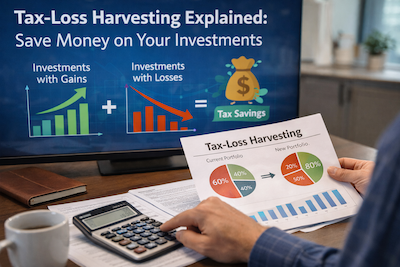
Tax-loss harvesting is one of those financial strategies that sounds more complicated than it actually is. At its core, it's simple: you sell investments that have lost value, use those losses to offset gains or reduce your taxable income, and then reinvest the proceeds in something similar to maintain your portfolio allocation.
Done well, tax-loss harvesting can save you thousands of dollars per year in taxes without meaningfully changing your investment strategy. It's one of the primary ways financial advisors add value beyond basic investment management — and it's a strategy that benefits most from consistent, year-round attention rather than a once-a-year review.
How Tax-Loss Harvesting Works
The Basic Mechanics
-
Identify a losing position. You own an investment that's worth less than what you paid for it. For example, you bought a total international stock index fund for $50,000 and it's now worth $43,000 — a $7,000 unrealized loss.
-
Sell the losing investment. You sell the fund, realizing the $7,000 loss. This loss now appears on your tax return.
-
Use the loss to offset gains. If you also sold other investments for a $7,000 gain this year, the loss cancels out the gain — and you owe zero tax on that gain.
-
Reinvest in something similar. You immediately buy a different but similar investment — for example, a different international stock index fund from another provider — so your portfolio allocation stays essentially the same.
The result: you maintain the same market exposure, but you've created a tax deduction.
What Losses Can Offset
Capital losses are applied in a specific order:
-
Short-term losses first offset short-term gains. Short-term gains (investments held less than one year) are taxed at your ordinary income rate — which can be as high as 37%. Offsetting these is especially valuable.
-
Long-term losses offset long-term gains. Long-term gains (investments held over one year) are taxed at preferential rates of 0%, 15%, or 20%.
-
Net losses offset ordinary income. If your losses exceed your gains, you can deduct up to $3,000 per year ($1,500 if married filing separately) against your ordinary income.
-
Excess losses carry forward. Any losses beyond the $3,000 annual deduction carry forward to future tax years indefinitely. You never lose an unused loss.
A Concrete Example
Without tax-loss harvesting:
- You sold Stock A for a $20,000 long-term gain
- Tax owed (at 15% capital gains rate): $3,000
- Tax owed (including 3.8% NIIT if applicable): $3,760
With tax-loss harvesting:
- You sold Stock A for a $20,000 long-term gain
- You also harvested a $15,000 loss from Fund B
- Net taxable gain: $5,000
- Tax owed: $750 (or $940 with NIIT)
- Tax savings: $2,250 - $2,820
And you've reinvested the Fund B proceeds into a similar fund, so your portfolio allocation is essentially unchanged.
The Wash Sale Rule
The IRS anticipated that people would sell investments for a loss and immediately buy them back. To prevent this, they created the wash sale rule.
What the Rule Says
If you sell an investment at a loss and buy a "substantially identical" security within 30 days before or after the sale, the loss is disallowed. The 30-day window applies in both directions — so it's really a 61-day window (30 days before, the sale date, and 30 days after).
What "Substantially Identical" Means
The IRS hasn't defined this term precisely, which creates some gray areas. Here's what's generally understood:
Clearly substantially identical (loss disallowed):
- Selling shares of Apple stock and buying Apple stock back within 30 days
- Selling shares of Vanguard S&P 500 Index Fund and buying them back
- Selling shares of a fund and buying an option on the same fund
Clearly NOT substantially identical (loss allowed):
- Selling Vanguard Total Stock Market Index Fund and buying Schwab Total Stock Market Index Fund (different fund, different provider, though they track similar indexes)
- Selling a large-cap growth fund and buying a total market fund
- Selling individual stock and buying an ETF that contains that stock
Gray area:
- Selling an S&P 500 index fund from one provider and buying an S&P 500 index fund from a different provider (same index, different fund — most tax professionals consider these not substantially identical, but the IRS hasn't explicitly ruled)
Wash Sale Pitfalls
Watch for these common mistakes:
- Automatic reinvestment: If your 401(k) automatically buys the same fund you just sold in your taxable account, it may trigger a wash sale
- Spouse's accounts: Wash sale rules apply across your and your spouse's accounts
- Dividend reinvestment: Automatic dividend reinvestment into a fund you just sold can trigger a wash sale
- The 30-day "before" window: If you buy a replacement first and sell the original within 30 days, it's still a wash sale
When Tax-Loss Harvesting Is Most Valuable
During Market Downturns
Market corrections and bear markets are the most obvious opportunities. When broad market indexes drop 10-20%, many positions will show losses that can be harvested. The 2020 pandemic crash, 2022 bear market, and periodic corrections all created significant harvesting opportunities.
When You Have Large Capital Gains
If you're selling a business, exercising stock options, selling concentrated stock positions, or realizing gains from real estate, harvested losses can offset those gains and save significant tax.
When You're in a High Tax Bracket
The higher your marginal tax rate, the more valuable each dollar of loss becomes. Someone in the 37% federal bracket saves $370 for every $1,000 of short-term losses harvested, compared to $120 for someone in the 12% bracket.
Year-Round, Not Just December
Many investors think of tax-loss harvesting as a December activity. In practice, the best opportunities often appear during the year when markets are volatile. An advisor who monitors your portfolio throughout the year can capture losses that may disappear by December if markets recover.
When Tax-Loss Harvesting Doesn't Make Sense
In Tax-Advantaged Accounts
There's no benefit to harvesting losses in IRAs, 401(k)s, Roth accounts, or other tax-advantaged accounts. Gains and losses in these accounts have no current tax impact.
When You're in a Low Tax Bracket
If your income puts you in the 0% long-term capital gains bracket (roughly under $44,625 for single filers or $89,250 for married filing jointly in 2024), you're not paying tax on long-term gains anyway. Harvesting losses to offset gains you wouldn't pay tax on wastes the losses.
When Transaction Costs or Tracking Complexity Outweigh Benefits
For very small portfolios, the tax savings from harvesting a $200 loss may not justify the record-keeping complexity.
When It Creates a Worse Tax Outcome Later
Tax-loss harvesting reduces your cost basis in the replacement investment. When you eventually sell the replacement, your gain will be larger (or your loss will be smaller) than it would have been without the harvest. You're deferring tax, not eliminating it.
However, deferral is still valuable because:
- A dollar of tax saved today and paid in 20 years is worth less than a dollar (time value of money)
- You may be in a lower tax bracket in retirement
- If you hold until death, the stepped-up basis may eliminate the deferred gain entirely
Advanced Strategies
Direct Indexing
Instead of owning an index fund, you own the individual stocks that make up the index. This creates hundreds of individual positions, each of which can be independently harvested when it dips below your purchase price. Direct indexing can generate 1-2% of additional tax alpha per year compared to holding a single index fund.
This strategy typically requires $100,000+ and is most commonly offered by advisors and robo-advisors with sophisticated tax management software.
Asset Location Coordination
Tax-loss harvesting works best when coordinated with your overall asset location strategy — the decision of which investments go in which account types. Placing tax-inefficient investments (bonds, REITs) in tax-advantaged accounts and tax-efficient investments (index funds, growth stocks) in taxable accounts maximizes harvesting opportunities.
Pairing with Roth Conversions
In a year when you harvest significant losses, you may be able to do a larger Roth conversion at a lower tax cost. The harvested losses offset the income from the conversion, effectively allowing you to move money from a traditional IRA to a Roth IRA at a discounted tax rate.
How Financial Advisors Add Value
Tax-loss harvesting is one of the clearest ways a financial advisor justifies their fee. A study by Vanguard found that systematic tax-loss harvesting can add up to 1.1% per year in after-tax returns for taxable portfolios — though the benefit varies significantly based on individual circumstances.
The value comes from:
- Year-round monitoring: Capturing opportunities as they arise, not just in December
- Wash sale compliance: Coordinating across all accounts to avoid inadvertent wash sales
- Replacement security selection: Choosing tax-efficient alternatives that maintain your allocation
- Integration with your tax plan: Coordinating harvesting with Roth conversions, charitable giving, and other tax strategies
- Record keeping: Maintaining accurate cost basis records across multiple transactions
The Bottom Line
Tax-loss harvesting is a proven strategy for reducing your investment tax bill without significantly changing your portfolio or taking on additional risk. It's not a get-rich-quick scheme — it's a disciplined, ongoing process that compounds over time.
For investors with taxable portfolios of $100,000 or more, the potential savings are meaningful enough to warrant attention. Whether you do it yourself or work with an advisor, understanding the mechanics ensures you're not leaving money on the table.
Use our directory to find advisors who specialize in tax-efficient investing and can implement systematic tax-loss harvesting as part of your overall financial plan.