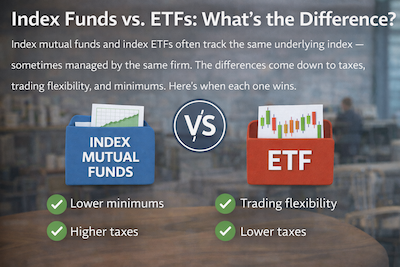
You've decided to invest in a low-cost index fund. Now you have to choose between an index mutual fund and an index ETF, and the two often track the same underlying index — sometimes from the same fund company. The S&P 500 is available as VFIAX (Vanguard's index mutual fund) or VOO (Vanguard's ETF) — same exposure, two different wrappers.
Most of the time it doesn't matter much. But the differences are real, and a few situations make one wrapper meaningfully better than the other.
What They Have in Common
Both index mutual funds and index ETFs:
- Track a published market index (S&P 500, Total Stock Market, MSCI EAFE, Bloomberg Aggregate Bond, etc.)
- Hold roughly the same underlying securities
- Charge low expense ratios (typically 0.03%–0.20% for major index products)
- Offer broad diversification within their stated market segment
- Can be held in retirement accounts (IRAs, 401(k)s) or taxable brokerage accounts
- Are subject to the same regulatory framework (the Investment Company Act of 1940)
For most investors, the choice between the two wrappers won't make or break a portfolio. The fund's underlying index, expense ratio, and consistency of tracking matter much more than the wrapper.
How They Differ
Trading mechanics
Mutual funds trade once per day, at the end of the trading day. You enter your order any time during the day; it executes at the 4:00 PM ET net asset value (NAV).
ETFs trade like stocks. You can buy or sell at any moment during the trading day at whatever the current market price is. You can use limit orders, stop orders, and conditional orders the way you would with individual stocks.
For a long-term index investor making regular contributions, the trading-mechanic difference is genuinely irrelevant. For someone who wants to react to market events intraday, the ETF wrapper offers flexibility — though "reacting to market events intraday" is a behavior most index investors should avoid anyway.
Tax efficiency in taxable accounts
This is the most consequential difference.
ETFs are typically more tax-efficient in taxable accounts because of how they handle redemptions. When ETF shareholders sell, the ETF doesn't have to sell underlying securities — large sellers exchange ETF shares for the actual underlying basket through "creation/redemption" units. This mechanism lets the ETF unload appreciated low-basis securities to redeeming shareholders without triggering capital gains for the remaining holders.
Mutual funds, by contrast, must actually sell underlying securities when shareholders redeem in net amounts. Those sales generate capital gains that are passed through to all remaining shareholders at year-end, even ones who didn't sell.
The practical impact: Vanguard, Fidelity, and Schwab S&P 500 index mutual funds have historically had small or zero capital gains distributions because of their sheer scale and stable shareholder base. But for less well-managed mutual funds — or for mutual funds in less liquid markets — capital gains distributions can be 1–3% of NAV per year, all taxable, even if you never sold a share.
ETFs largely avoid this problem. For taxable accounts, the structural tax advantage of ETFs has been worth roughly 0.2–0.5% per year on average over the last decade.
In tax-advantaged accounts (IRA, 401(k), Roth IRA), this difference doesn't matter at all — capital gains distributions inside a tax-deferred account aren't taxable. Choose either freely.
Expense ratios
Generally similar between equivalent products from the same fund company. A few examples (2024 data):
| Index | Mutual Fund | Expense | ETF | Expense |
|---|---|---|---|---|
| S&P 500 | VFIAX (Vanguard) | 0.04% | VOO (Vanguard) | 0.03% |
| Total US Market | VTSAX (Vanguard) | 0.04% | VTI (Vanguard) | 0.03% |
| Total International | VTIAX (Vanguard) | 0.11% | VXUS (Vanguard) | 0.07% |
| Total Bond | VBTLX (Vanguard) | 0.05% | BND (Vanguard) | 0.03% |
Vanguard's ETF share class is typically a few basis points cheaper than the mutual fund share class — small, but real. At Fidelity and Schwab, the gap is often zero or even reversed (their flagship index mutual funds have 0% expense ratios as a customer-acquisition tool).
For a $100,000 holding, the difference between 0.03% and 0.04% is $10/year. Real money, but not the largest factor in the decision.
Minimum investment
Mutual funds typically require a minimum to open the position — $1,000 to $3,000 is common at Vanguard, Fidelity, and Schwab. Some lower-tier mutual funds have $0 minimums.
ETFs have no minimum beyond the price of one share — VOO around $530 as of recent prices, VTI around $290. With fractional shares (now offered by Schwab, Fidelity, and Vanguard), you can buy as little as $1 of an ETF.
For a small first investment ($500 or less), ETFs are more accessible.
Automatic investing
Mutual funds have always supported automatic recurring investments — schedule a $500 monthly transfer from your checking account, and the brokerage automatically buys the right number of shares (or fractional shares) at the next NAV.
ETFs historically didn't support automatic recurring investments well, but that's changed. Schwab, Fidelity, and most major brokerages now support automatic recurring ETF purchases including fractional shares.
For practical purposes, both wrappers now support automatic investing equally well at major brokerages.
Trading costs
Both are typically free to trade at major brokerages today. Years ago, ETFs had small commissions per trade and mutual funds had loads — both are mostly history. Be aware:
- Mutual funds outside your brokerage's no-transaction-fee list may charge $25–$75 per trade.
- ETFs are commission-free at all major brokerages but have a bid-ask spread (the difference between buy and sell price) — typically a penny or two on liquid index ETFs, more on smaller funds.
For a regular monthly contribution of a few thousand dollars into a popular index ETF, total transaction friction is usually well under $1.
Bid-ask spreads (ETF-specific)
ETFs trade at market price during the day, which can deviate slightly from the underlying NAV. For massively liquid funds (VOO, SPY, VTI, BND), the spread is typically a penny — irrelevant. For thinly traded ETFs (small sector funds, niche international funds), spreads can be 0.10%–0.50%, which matters.
Stick to ETFs with daily volume over 1 million shares to avoid this.
When to Choose Which
Choose ETFs when:
- You're investing in a taxable account. The structural tax efficiency matters over the long term.
- You're starting small. Lower minimums; fractional shares.
- You want flexibility to trade during the day for any reason (rebalancing, harvesting losses precisely, executing limit orders).
- The expense ratio is meaningfully lower than the mutual fund equivalent.
- You may move brokerages. ETFs transfer cleanly between any brokerage; some mutual funds (especially proprietary ones) only exist at one custodian.
Choose index mutual funds when:
- You're investing in a tax-advantaged account. No tax-efficiency advantage to ETFs here. Mutual funds are sometimes a few cents cheaper in expense ratio at Fidelity and Schwab.
- You want exact-dollar contributions to fully invest each pay period. Mutual funds buy at NAV, so a $500 contribution buys exactly $500 worth. (ETFs do this too with fractional shares, but it's slightly less mature at some brokerages.)
- You want the simplicity of a single end-of-day price. Less to think about.
- The mutual fund is part of a 401(k) lineup where ETFs may not be available.
For most retirement investors, index mutual funds and index ETFs are interchangeable at the level that matters.
Common Pairings
For a long-term index portfolio, the typical building blocks at each major fund company:
Vanguard
- VTI / VTSAX — Total US Stock Market
- VXUS / VTIAX — Total International Stock Market
- BND / VBTLX — Total US Bond Market
Fidelity
- FZROX — Total US Stock Market (zero expense ratio, mutual fund only — not transferable to other brokerages)
- FSKAX — Total US Stock Market (the transferable mutual fund version)
- FZILX — Zero International Index (mutual fund only)
- FXNAX — US Bond Index
Schwab
- SCHB — US Broad Market ETF
- SWTSX — Total Stock Market Index (mutual fund)
- SCHF — International Equity ETF
- SCHZ — US Aggregate Bond ETF
iShares (BlackRock)
- ITOT — Total US Stock Market ETF
- IXUS — Total International Stock ETF
- AGG — US Aggregate Bond ETF
These products are all roughly interchangeable in their respective categories. Pick the one available in your account, with the lowest expense ratio, and the right wrapper for your account type.
A Note on "Index Fund" vs. "Index ETF" Marketing
Some products are marketed as "index funds" but are actually actively-managed funds with a benchmark — so always check. A true index fund (or index ETF) tracks a published market index methodologically, with the goal of matching index returns minus expenses. An "actively managed fund using the S&P 500 as a benchmark" is a different animal entirely, often with higher expenses and different tax characteristics.
If the prospectus says "the fund seeks to track the performance of the [index]," it's a true index fund. If it says "the fund seeks to outperform the [index]," it's actively managed.
The Bottom Line
For tax-advantaged accounts (IRA, Roth, 401(k)), pick whichever wrapper your brokerage offers at the lowest expense ratio. The structural differences don't matter inside a tax shelter.
For taxable accounts, ETFs have a real and durable tax-efficiency advantage. Default to the ETF version unless there's a specific reason not to.
For everything else — automatic investing, dollar-cost averaging, simplicity — the two wrappers are equivalent enough that personal preference is fine.
The much bigger questions are which index to invest in, what allocation to hold across asset classes, and whether you'll stay invested through the inevitable downturns. The wrapper is a footnote.
If you'd like help thinking through a complete portfolio strategy, our directory lists fiduciary advisors who specialize in investment management across every state. Verify any advisor on FINRA BrokerCheck before you commit.