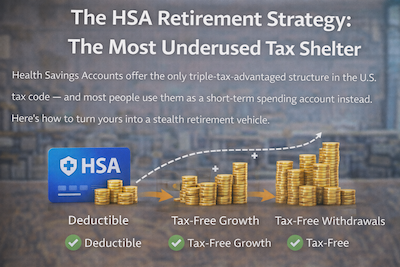
If someone told you there was a retirement account you could contribute to pre-tax, that grows tax-free, AND that comes out tax-free when you use it — all three at once — you'd expect everyone to be shouting about it. The Health Savings Account (HSA) does exactly that. It's the only account in the U.S. tax code with this "triple tax advantage."
And most people who qualify for one use it like a short-term spending account. Contribute a bit, spend it on the year's medical bills, and leave nothing invested.
This is the most consequential unforced error in personal finance for the middle class. Here's how to use the HSA correctly.
The Three Tax Advantages
1. Tax-deductible contributions
Money you put into an HSA reduces your taxable income, dollar for dollar, regardless of whether you itemize. If you contribute $4,000 and you're in the 22% federal bracket, you save $880 in federal tax. Plus state tax savings in most states (though California and New Jersey tax HSA contributions at the state level — a small asterisk for residents of those states).
Employer HSA contributions through payroll deduction also avoid FICA taxes (Social Security and Medicare — 7.65%), which neither a Traditional 401(k) nor an IRA does. That's an extra ~7.65% of savings on payroll-deducted contributions that you don't get from any other retirement account.
2. Tax-free growth
Money inside an HSA grows tax-free. Interest, dividends, capital gains — none of it is taxed as it accumulates. Same treatment as a Roth IRA or a 401(k).
3. Tax-free withdrawals for qualified medical expenses
When you spend HSA funds on qualified medical expenses, no tax is owed on the withdrawal. Ever. This is the part that makes HSA treatment unique — a Traditional 401(k) gets you deferred tax, a Roth IRA gets you tax-free growth after paying tax upfront, but only the HSA gets you pre-tax contributions AND tax-free withdrawals simultaneously.
What counts as "qualified medical expenses": a very long list. Doctor visits, hospital bills, prescriptions, dental, vision, physical therapy, mental health, long-term care, Medicare premiums in retirement (Part B, Part D, Medicare Advantage — but not Medigap), hearing aids, most over-the-counter medications, and more. The IRS publishes the list in Publication 502.
Who Qualifies
You can contribute to an HSA only if you're enrolled in a High Deductible Health Plan (HDHP). The IRS defines HDHP thresholds annually:
For 2024:
- Single coverage: minimum $1,600 deductible, maximum $8,050 out-of-pocket
- Family coverage: minimum $3,200 deductible, maximum $16,100 out-of-pocket
If your health plan doesn't meet the HDHP thresholds, you can't contribute (but you can still use an existing HSA balance from a prior HDHP year).
Other disqualifiers:
- Enrolled in Medicare
- Claimed as a dependent on someone else's tax return
- Have other non-HDHP coverage (including a general-purpose FSA from a spouse's plan)
2024 Contribution Limits
- Single: $4,150
- Family: $8,300
- Age 55+ catch-up: additional $1,000 per year (per HSA-holder, not per family)
These limits include any employer contributions. If your employer kicks in $1,500, you can contribute $2,650 (single) to hit the $4,150 cap.
The Retirement Strategy: Stop Spending the Balance
The default HSA behavior — and how most people use it — is to put money in, spend it on this year's doctor visits, and end the year roughly at zero. That's using it as a tax-advantaged spending account, which is useful but leaves massive value on the table.
The optimal strategy (for people who can afford it) has three components.
1. Contribute the maximum every year.
Even in years when you have low medical expenses. The HSA limit you don't use this year is gone forever — you can't make up for it later.
2. Pay current medical expenses from after-tax money.
Out of pocket, from your checking account or savings. Keep receipts.
3. Invest the HSA balance in low-cost index funds and let it grow.
Most HSA providers offer investment options (Fidelity, Lively, HealthEquity). The money compounds tax-free for decades. Save your medical receipts forever — you can reimburse yourself from the HSA for any qualified medical expense incurred after the HSA was opened, at any time in the future, with no deadline.
The payoff: you've compounded decades of investment returns in a tax-sheltered account, and you can pull it out whenever you want (tax-free) by matching against old receipts. Or wait until retirement and use it for Medicare premiums and any age-related medical costs.
The age-65 bonus rule
At age 65, the HSA becomes even more flexible. You can withdraw for any reason (not just qualified medical expenses) — you just pay ordinary income tax on the withdrawal, same as a Traditional IRA. No 10% penalty for non-medical withdrawals after 65 (that penalty exists for under-65 non-medical withdrawals).
So an HSA in retirement operates like:
- Traditional IRA for non-medical expenses (pay income tax, no penalty)
- Roth IRA for medical expenses including Medicare premiums (tax-free)
This makes the HSA the single most flexible retirement account available — provided you let it grow instead of spending it along the way.
The Math on Compounding
Contribute the family maximum of $8,300 per year for 20 years, earning 7% average return, invest in index funds. Ending balance: approximately $363,000 — all tax-free for qualified medical expenses, and treated like a Traditional IRA for any other withdrawal at 65+.
Now compare to using the HSA as a spending account:
- Contribute $8,300 annually, spend $8,300 annually on current medical bills.
- 20-year ending balance: $0. You saved tax on the contributions each year (~$1,700 annually at 22% bracket = $34,000 over 20 years in tax savings), but you've forgone $329,000 of tax-free growth.
The tax savings on contributions alone are meaningful, but they're an order of magnitude smaller than what the compounding could have been.
When the Strategy Doesn't Work
The HSA retirement strategy assumes you can afford to pay current medical expenses out of pocket while your HSA compounds. For most middle-income families with occasional medical bills and adequate cash flow, this works. For families with:
- Chronic conditions requiring ongoing expensive treatment
- Income that's already tight after basic expenses
- An HDHP deductible that would be crushing in a medical emergency
...the HSA is more valuable as a spending account than as a retirement vehicle. Covering real current medical bills tax-free is still genuinely useful; it's just not the same leverage as investing and letting it compound.
Common Mistakes
Not investing the balance
Most HSAs default to holding contributions in a cash account earning near-zero interest. You typically have to affirmatively opt into investing, and there may be a minimum cash balance you must maintain (e.g., $2,000 stays liquid, anything above invested). Check your HSA provider's rules and actively set up the investment sweep.
Not saving receipts
To use the "pay out of pocket now, reimburse yourself later" strategy, you need documentation. Save every medical receipt — digital scans or photos work — tagged to the year incurred. When you want to reimburse yourself 15 years from now, you produce the old receipt and withdraw tax-free.
Assuming the HSA vanishes if you change jobs
It doesn't. HSAs are owned by you, not your employer, unlike an FSA. When you leave a job, the HSA comes with you. You can roll it to a different HSA provider (most major brokerages offer consumer-direct HSAs with low fees and good investment options).
Using it for ineligible expenses
Non-medical withdrawals before age 65 trigger ordinary income tax plus a 20% penalty. Don't touch it for anything except qualified medical expenses until 65. If you made a mistake and withdrew for non-qualified reasons, you can return the funds within 60 days.
Letting an employer HSA stagnate at a high-fee custodian
Many employer-sponsored HSAs have terrible investment options and annual fees. You're not stuck — you can periodically roll your HSA to a better custodian while still employed. Fidelity's HSA has $0 fees and full brokerage investment options; it's one of the best available.
The Bottom Line
The HSA is the single most tax-efficient account in the U.S. retirement landscape, and it's massively underused. If you're enrolled in an HDHP, max the contribution, invest the balance in low-cost index funds, pay current medical bills from after-tax money, and save every receipt.
Over a 20+ year career of consistent HSA contributions used this way, you can build a six-figure tax-free medical-reimbursement account that doubles as a flexible retirement fund at age 65. The main obstacle is behavioral — it requires treating the HSA as a long-term investment rather than a short-term spending account, which is counter to how most HSA providers frame the product.
If you'd like to coordinate HSA strategy with the rest of your retirement plan, our directory lists fiduciary advisors who specialize in tax-efficient retirement planning across every state. Verify any advisor on FINRA BrokerCheck before you commit.