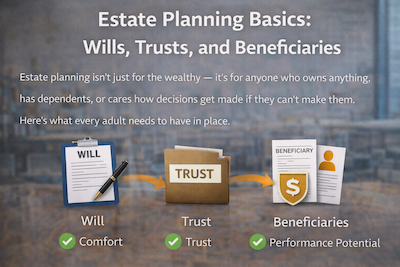
The phrase "estate planning" sounds like something for people with estates — large properties, complicated wealth, significant assets to pass on. That framing is wrong, and it's one of the reasons so many adults don't have the basic documents in place. Estate planning is what makes sure (a) your assets go where you want them to go, (b) someone you trust can make medical and financial decisions if you can't, and (c) the people you care about aren't stuck navigating a bureaucratic mess during the worst week of their lives.
Every adult who owns something, has dependents, or cares about any of the above needs a basic estate plan. Here's what that actually means.
The Four Core Documents
Most estate plans boil down to four documents. If you have all four, properly executed and kept current, you've covered the vast majority of what matters.
1. Last Will and Testament
A will is a legal document that specifies:
- Who gets your assets that pass through probate (more on that below)
- Who becomes guardian of your minor children
- Who serves as executor (the person responsible for carrying out your wishes)
- Any specific gifts, charitable bequests, or instructions
What a will does not control: assets with a named beneficiary (retirement accounts, life insurance, transfer-on-death brokerage accounts) or assets held in joint ownership with right of survivorship. Those pass directly to the named beneficiary or surviving owner, regardless of what your will says.
If you die without a will (intestate): state law determines who gets your property. Each state has intestate succession rules, and they rarely match what most people would actually want. Spouses typically get some portion, children get the rest, and if you're unmarried with no children, it flows to parents, siblings, nieces/nephews, and so on. The court also appoints a guardian for minor children using its own judgment, which may not be the person you'd have picked.
2. Healthcare Power of Attorney (or Healthcare Proxy)
This document names one person to make medical decisions for you if you become incapacitated. Without it, doctors have to rely on state law — often defaulting to next-of-kin — and the person who ends up with authority may not be the one you'd have chosen.
Paired with this is typically a living will or advance directive that specifies your wishes about end-of-life care: whether you want life-sustaining treatment in terminal situations, whether you consent to organ donation, and similar specific instructions.
3. Durable Financial Power of Attorney
This names someone to manage your financial affairs if you become incapacitated — pay bills, access accounts, sign documents, file taxes. Without it, family members may have to petition for court-ordered conservatorship, which is expensive, slow, and public.
"Durable" means the authority continues even after you become incapacitated. A non-durable POA ends the moment you can't make your own decisions — which is exactly when you'd need someone to step in. Always make it durable.
4. Beneficiary Designations
Not a single document, but a category. Every account or policy with a "beneficiary" field has one — and these designations override your will.
Accounts to check:
- 401(k), 403(b), 457, and similar employer retirement plans
- Traditional IRA, Roth IRA, SEP IRA
- Life insurance policies (employer-provided AND individually purchased)
- Annuities
- Transfer-on-death (TOD) designations on taxable brokerage accounts
- Pay-on-death (POD) designations on bank accounts
- Health Savings Accounts (HSAs)
The most common estate-planning mistake in America is an outdated beneficiary designation — the ex-spouse still listed as 401(k) primary, the deceased parent still named on a life insurance policy, the sibling named 20 years ago who's no longer close. These override your will. Audit all of them today.
Wills vs. Trusts
The distinction between a will and a trust confuses a lot of people. Here's the short version.
What a will does
Directs the distribution of your probate estate — the assets that go through probate, the court-supervised process of validating a will and transferring property. Probate is public, slow (typically 6–18 months), and moderately expensive (court fees, attorney fees, filing costs — often 3–8% of estate value).
What a revocable living trust does
A revocable living trust holds title to your assets while you're alive. You're both the grantor (the person who set it up) and the trustee (the person managing it). At your death, a successor trustee you've named takes over and distributes the assets according to your instructions — without going through probate.
Advantages of a revocable trust:
- Avoids probate (faster distribution, lower cost, stays private)
- Continues functioning if you become incapacitated (your successor trustee steps in)
- Works across states — assets held in multiple states don't each go through separate probate proceedings
Disadvantages:
- Setup cost (typically $2,000–$5,000 to have an attorney draft one properly)
- Requires "funding" — retitling your assets into the trust. A trust without funded assets is just paper; it has to actually own the things it's supposed to distribute.
- Doesn't save estate tax — revocable trusts don't reduce your taxable estate
When a revocable trust is worth the expense:
- You own real estate in multiple states
- You want your financial affairs to remain private after death
- You have significant assets that would otherwise face lengthy probate
- You've had a recent brush with incapacity and want continuity planning
When a will alone is sufficient:
- Young or middle-aged with modest assets
- Assets mostly held in accounts with beneficiary designations (which already avoid probate)
- Single state, no complex family situation
There are also irrevocable trusts — used primarily for estate tax reduction, asset protection, and complex family arrangements. These are specialized tools and almost always require an estate-planning attorney to design and maintain.
Estate Tax: What Most People Actually Need to Know
At the federal level, the estate tax exemption is $13.61 million per person in 2024 — effectively $27.22 million for a married couple with proper planning. The vast majority of Americans die with estates well below this threshold and owe no federal estate tax.
Important: this exemption is scheduled to drop by about half at the end of 2025 unless Congress extends the 2017 Tax Cuts and Jobs Act. Even at the reduced level (~$7M per person), most estates still won't be taxable.
State-level estate tax is the trap. Twelve states plus DC have their own estate taxes, often at much lower thresholds than the federal level:
- Massachusetts: $2 million
- Oregon: $1 million
- Washington: ~$2.2 million
- New York: ~$7 million (with a cliff — cross it and the entire estate becomes taxable, not just the excess)
- Connecticut, Illinois, Maine, Maryland, Minnesota, Rhode Island, Vermont, Hawaii: various thresholds
Six states also impose inheritance taxes on the recipient (Iowa, Kentucky, Maryland, Nebraska, New Jersey, Pennsylvania). These are paid by the person inheriting, not the estate — with different rules and exemptions.
If you live in one of these states, or own property in one, state-level planning matters even if federal isn't an issue. An estate planning attorney familiar with your state can structure things (revocable trust, bypass trust for married couples, lifetime gifting) to minimize what the state takes.
Common Mistakes
Outdated beneficiaries
Already covered. Review annually.
Naming a minor child as a beneficiary
Minors can't directly inherit substantial assets. If you name a minor without specifying how the assets are held (e.g., via a trust or UTMA account), the court will appoint a guardian of the property — not necessarily the person you'd choose.
Naming an estate as a retirement account beneficiary
This forces the retirement account through probate and accelerates the required distribution period, often triggering a large tax bill. Always name actual human beneficiaries (or a trust designed to receive retirement assets) on 401(k)s and IRAs.
Blended families not addressed
If you have children from a prior relationship and remarry without updating your estate plan, your new spouse may inherit everything — and your children from the prior marriage may be cut out entirely, depending on state law and account titling. Blended families especially need professional estate planning.
Skipping the healthcare documents
Most people who skip estate planning figure "the will is the important part." The healthcare POA and living will are arguably MORE important during your lifetime because they determine who can make medical decisions if you're unconscious or incapacitated. Without them, families fight, hospitals wait, and decisions get made by committee.
DIY-ing something complex
Simple estates with modest assets and straightforward family situations are fine with online services (Trust & Will, LegalZoom, basic state-specific will forms). Complex situations — business interests, blended families, significant real estate, special needs children, multi-state residency — need an estate planning attorney. The cost ($2,000–$8,000 for a full plan) is small compared to what mistakes cost.
What to Do This Month
If you have no estate plan at all:
- Name beneficiaries on everything (5 minutes each, entirely free). This is 80% of the benefit.
- Create a healthcare POA and living will. Every state has free forms available from state bar associations or health-system websites. Can be notarized at a bank branch for free.
- Create a simple will. If your situation is simple, an online service ($50–$200) or state-specific form is adequate. If it's complex, hire an attorney.
- Create a durable financial POA. Often bundled with the will if you use a service.
- Tell your designated people where the documents are. A locked safe with no one knowing the combination serves no one.
If you have a plan but haven't reviewed it in 5+ years:
- Audit beneficiaries on every account. Pay extra attention to accounts from jobs you've left.
- Confirm your designated executor, healthcare proxy, and financial POA agent are still the right people and still alive and willing.
- Check the state exemption threshold for your current residence. If you've moved states, you may need an updated plan.
- Review if major life changes have occurred — marriage, divorce, births, deaths, business sale, significant wealth change.
The Bottom Line
Estate planning is an act of care for the people you leave behind and for your future self if you ever become incapacitated. The core documents — will, healthcare POA, financial POA, and current beneficiary designations — aren't expensive or complicated for most families. Not having them is.
If your situation involves significant assets, real estate in multiple states, a business, blended family, or tax exposure, work with an estate planning attorney. Coordinate with your CFP to make sure the beneficiary structure across your accounts matches your estate plan's intent.
Our directory lists fiduciary financial advisors across every state, many of whom work regularly with estate planning attorneys and can refer you to one in your area. Verify any advisor on FINRA BrokerCheck before you commit.