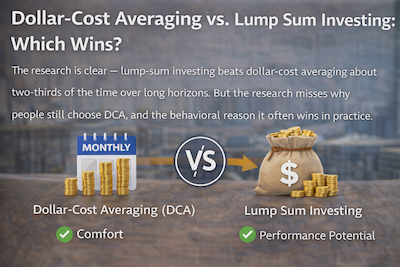
You just got a $100,000 inheritance, or the business sale closed, or the IRA rollover hit your new account. Do you invest it all at once? Or do you spread the contributions over the next 12 months?
The math has a clear answer. The behavior has a different one. This is the classic tension in personal finance — optimal decisions and the decisions actual humans make are often not the same, and the interesting question is what to do about it.
Definitions
Lump-sum investing
You invest the entire amount immediately at your target allocation. If you're investing $100,000 into a 70/30 portfolio, on day one $70,000 goes into equity index funds and $30,000 into bond funds. Done.
Dollar-cost averaging (DCA)
You split the amount into equal tranches and invest them on a schedule — typically monthly over 6 to 12 months. $100,000 over 12 months means $8,333 per month. In between tranches the un-invested money sits in cash or a short-term bond fund.
(Note: "dollar-cost averaging" is sometimes used loosely to describe regular automatic contributions from a paycheck. That's a different thing — it's just how most people invest, not a strategic decision. The term in this article refers specifically to the deliberate spreading of a lump sum over time.)
What the Research Shows
The most-cited study is Vanguard's 2012 paper "Dollar-Cost Averaging Just Means Taking Risk Later" (updated and re-published in 2023). They examined rolling 10-year periods of U.S. market history and asked: if you had a lump sum, would investing it all at once or spreading it over 12 months have given you the higher ending balance?
The results:
- Lump-sum investing beat 12-month DCA approximately 67% of the time across all rolling 10-year periods since 1926.
- The average outperformance of lump sum was about 2.3 percentage points over 12 months. Meaningful but not massive.
- Extended to a 60/40 portfolio, the win rate was 66%. In bonds-only, 63%. The structural effect holds across asset classes.
- Similar results were found in UK and Australian data.
Why lump sum wins on average: markets trend up more often than they trend down. About 7 out of 10 months in U.S. market history, the S&P 500 has closed higher than it opened. Holding cash instead of being invested means forgoing expected returns, on average. The 33% of periods where DCA wins are the periods following a major peak — where markets fell meaningfully during the DCA window and your later tranches bought at lower prices.
Why this result isn't the whole story:
- The study measures expected terminal wealth, not risk-adjusted returns.
- It doesn't account for the psychological cost of watching a lump sum drop 30% the month after you invested it.
- It doesn't address the possibility that you'd stop investing altogether if the market dropped 30% immediately — which is the real behavioral risk.
The Behavioral Argument for DCA
Here's the case for DCA that the pure math ignores.
Imagine you invest $100,000 as a lump sum on a Tuesday. On Friday, the market is down 5%. You're now looking at a paper loss of $5,000 in three days. You can live with that — it's a small fluctuation in the grand scheme.
Now imagine the same scenario, except the market keeps dropping. A week later you're down 15%. A month later, down 25%. Six months later, down 35%.
What do you actually do? The optimal answer is "stay invested, continue as planned, even add to positions at these lower prices." The actual answer for most people is a mix of anxiety, checking the account obsessively, second-guessing the decision, and — for the non-trivial fraction of investors who panic-sell at market bottoms — bailing out near the low.
If you DCA'd instead, after a 35% drop you'd have only invested about half your money (assuming 6 months into a 12-month plan). Your paper loss is half as much. You'd feel somewhat better. And critically, you might actually stay invested rather than abandoning the plan entirely.
The sophisticated version of this argument: DCA is insurance against your own behavior. The premium you pay for this insurance is the expected-return giveup (about 2.3 percentage points over a year, per the Vanguard study). For investors whose self-knowledge includes a realistic assessment that they'd panic-sell in a severe drawdown, paying that premium is rational.
For investors who've genuinely proven they can stay invested through volatility (held through 2008, held through 2020, held through 2022), the expected-return optimization of lump-sum investing is generally the better choice.
Hybrid Approaches
You don't have to pick one pure strategy. Common hybrid approaches:
50/50 split
Invest half the lump sum immediately; DCA the other half over 6 months. Captures most of the expected-return upside of lump sum while reducing timing anxiety.
"Trigger" DCA
Invest the lump sum immediately. But if the market drops by a predefined threshold (say, 10%), invest an additional taxable-account amount from savings. Instead of spreading out your inheritance, you spread out a new contribution — market drops become buying opportunities rather than anxiety triggers.
Valuation-based
A variant some disciplined investors use: invest the lump sum immediately in the bond portion of your target allocation, and DCA the equity portion. The bonds still earn interest while you slowly deploy equity. Gives you some of both worlds, more conservative than 100% immediate.
Where DCA Is Actually Wrong
Some situations where "dollar-cost averaging a lump sum" really is a mistake:
Regular paycheck contributions
If you're investing $500 of each paycheck into a 401(k), that's regular automatic investing, not DCA in the lump-sum sense. Don't accumulate the $500 in cash and invest it monthly (that IS DCA and it's suboptimal). Just contribute immediately each pay period.
Very long horizons with stable temperament
For a 30-year-old rolling over a $50,000 401(k) to an IRA and has 35 years of runway, there's not much behavioral or mathematical case for DCAing it. Just invest it at target allocation.
When DCA drags on too long
12 months is about the longest DCA window that makes mathematical sense; beyond that, you're simply holding cash for no reason. 24-month or "whenever the market feels right" DCA plans are procrastination dressed up as strategy.
When the money is urgently needed to be working
If you're 62 retiring at 65 and hoping to earn compound returns between now and then, DCA-ing over 12 months costs you meaningful time. Lump sum or a short (3–6 month) DCA is probably better.
A Practical Decision Framework
Ask yourself three questions:
1. Am I genuinely disciplined about staying invested through drawdowns?
If yes — you stayed fully invested through 2008, 2020, 2022 — lump sum makes sense.
If no — you pulled money out during any of those, or weren't invested then and don't know — DCA or hybrid for peace of mind.
2. How big is this lump sum relative to my existing portfolio?
If the lump sum is less than 20% of your existing investment portfolio, the behavioral risk is lower — a bad timing of the new money is cushioned by the rest of your holdings. Lump sum is more defensible here.
If the lump sum is most or all of your investable assets (especially an inheritance or business sale), the behavioral stakes are higher. DCA or hybrid is often the right call.
3. What's the time horizon?
Short (under 5 years): mostly irrelevant — market volatility dominates either approach. The allocation decision matters more than the timing decision.
Medium (5–15 years): lump sum is slightly better on average; DCA is more psychologically comfortable. Reasonable to pick either.
Long (15+ years): lump sum strongly preferred. The expected-return giveup from DCA compounds meaningfully over decades.
The Bottom Line
On average, lump-sum investing beats dollar-cost averaging about two-thirds of the time over long horizons. The average outperformance is modest — about 2.3 percentage points over a year — but it compounds.
DCA's real value is as behavioral insurance against panic-selling during an immediate post-investment drawdown. If you genuinely have the temperament to stay invested, pay the expected-return premium of lump sum and move on. If you don't, a 6-to-12-month DCA plan is a rational compromise — but don't stretch it longer and don't dress up procrastination as strategy.
Either way: do it now. The single biggest mistake isn't picking lump sum or DCA — it's leaving the money in cash for months or years while you decide. "Time in the market" outperforms "timing the market" on essentially every historical measurement.
If you'd like help thinking through a deployment plan for a specific lump sum — especially one with tax considerations (inheritance, business sale, Roth conversion window) — our directory lists fiduciary advisors who specialize in investment management across every state. Verify any advisor on FINRA BrokerCheck before you commit.